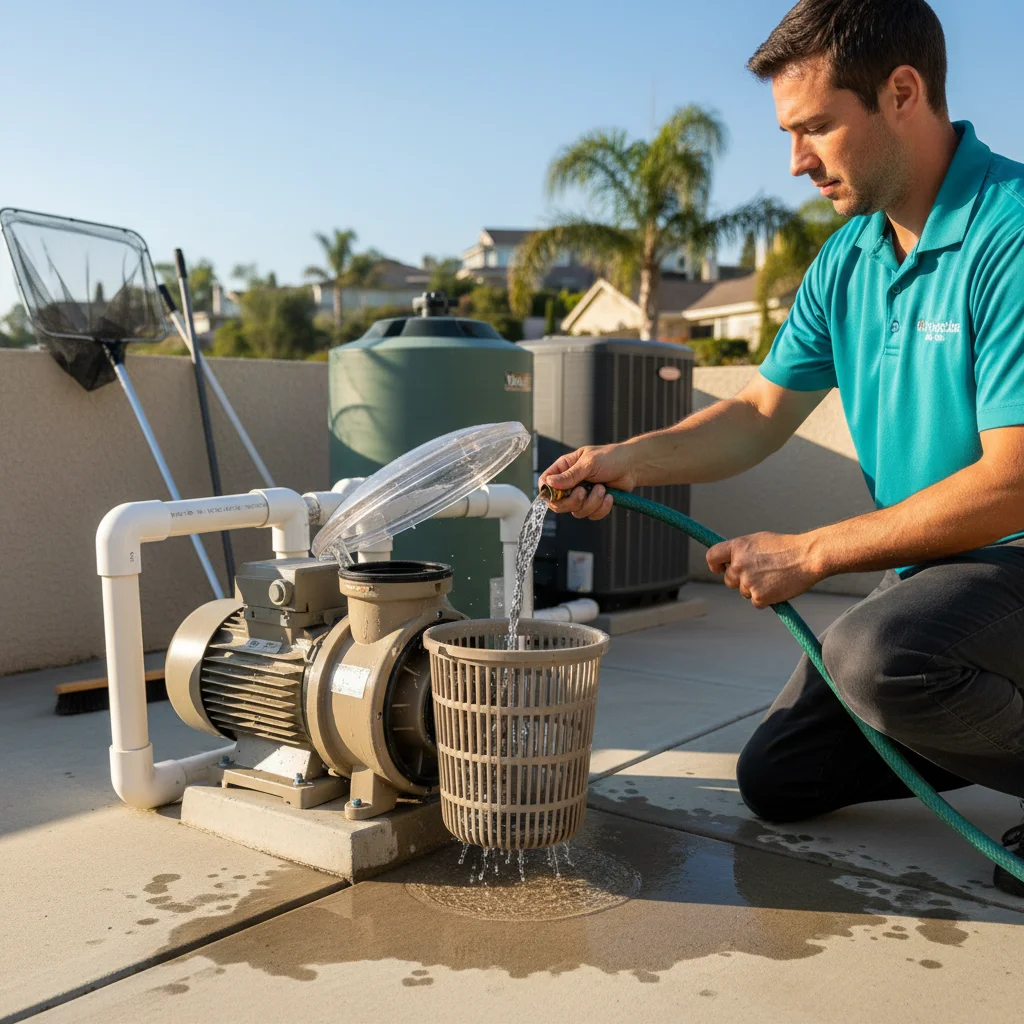
A pool pump that won’t turn on usually isn’t a mystery. It’s failing at one of a handful of predictable points, and most of those points are cheap and quick to check before you assume the whole pump is dead. The trick is working through them in order instead of jumping straight to a replacement.
Refresh Pool Pros connects San Diego homeowners with vetted pool repair specialists who diagnose pump failures fast. This guide walks through the checks a homeowner can safely do, what a hum versus dead silence actually tells you, and where the line sits between a DIY fix and a job for a licensed pro.
Start with the breaker and GFCI outlet
A tripped breaker is the single most common reason a pool pump shows no signs of life at all. Pool equipment typically runs on its own dedicated circuit, so check that breaker specifically rather than assuming the whole panel is fine. If the breaker trips again the moment you reset it, or trips again within a few minutes of running, stop resetting it. That pattern usually means a short in the wiring or a motor pulling more current than it should, and it needs an electrician or pool repair pro before you touch it again. Also check the GFCI outlet at the equipment pad if your setup uses one, since San Diego’s coastal humidity corrodes outdoor GFCI contacts faster than inland installations and they can trip without warning.
Check the timer next
A failed timer is the second most common cause of a pump that stays dark and silent. Mechanical timers use a spring-driven clock and trip pins that wear out or slip out of position over years of use, while digital timers can lose their programming after a power outage or a dead backup battery. Confirm the timer’s clock shows the correct time and that the trip pins or program are actually set to run during the hours you expect. A timer stuck in the off position looks identical to a dead pump from the homeowner’s side, and it’s one of the cheapest fixes on this list when that’s actually the problem.
A pump that hums but won’t start
If the pump makes a humming sound for a second or two and then goes silent, or hums continuously without the motor spinning, that’s a different problem than no power at all. A humming pump usually points to a failing capacitor, the small electrical component that gives the motor the initial push it needs to start turning. Capacitors degrade with age and heat, and San Diego’s warm equipment pads accelerate that wear over a pump’s lifespan. Humming can also mean the motor shaft or bearings have seized, often from corrosion or years of dust and debris working into the housing. Both problems require opening the motor, which is a job for a licensed pool repair specialist rather than a homeowner with a screwdriver.
Overheated motors and thermal cutoffs
Pool pump motors have a thermal cutoff switch that shuts the motor down automatically if it overheats, protecting the windings from burning out. A pump that ran fine earlier in the day and then quietly stopped, especially during a hot inland afternoon in El Cajon or Santee, may simply be an overheated motor waiting to cool down before it will restart. Give it 30 to 60 minutes and try again. If it trips on thermal cutoff repeatedly, even after cooling, that points to a motor working harder than it should, often because of a clogged impeller, a failing bearing, or a motor that’s simply reaching the end of its service life.
Seized bearings and corroded wiring
Pumps that sit unused for stretches, or that run in salty coastal air near La Jolla, Coronado, or Pacific Beach, are prone to seized bearings and corroded electrical connections. A seized motor shaft won’t turn even with full power reaching it, and forcing it can damage the motor beyond repair. Corroded wiring at the pump’s electrical connections is a slower failure, but it shows up as intermittent power, a pump that works sometimes and not others, or connections that look green or crusted when you open the junction box. Both of these are jobs for a licensed specialist, since diagnosing a seized motor versus a wiring fault requires testing equipment most homeowners don’t have on hand.
A bad automation relay
Homes with automated pool systems sometimes have a pump that won’t respond simply because the automation relay controlling it has failed, not the pump itself. If your system uses an app or a control panel to start the pump and nothing happens, but the pump runs fine when triggered manually at the timer or breaker, the relay or its wiring is the likely culprit. This is a more specialized repair, since it involves the automation controller rather than the pump’s own electrical components.
What a homeowner can safely check versus when to call a pro
Everything up through the breaker, GFCI outlet, and timer is safe territory for most homeowners to check on their own. Past that point, you’re dealing with the motor, capacitor, wiring, or automation system, and all of those carry real electrical risk if handled without the right training and tools. A pump that’s silent with power confirmed at the outlet, one that hums without starting, or one that trips breakers repeatedly should go straight to a licensed pool repair specialist rather than continued troubleshooting.
Refresh Pool Pros connects San Diego homeowners with vetted pool repair specialists who diagnose pump failures on the same visit in most cases. If your pump is running but leaking at the seal or housing instead of failing to start, our guide on pool pump leaking water covers that separate problem. And if the pump is old enough that repair costs are starting to add up, see our breakdown of repair versus replace for a pool pump and what pump replacement actually costs in San Diego before you commit to either path.
Frequently asked questions
Why won’t my pool pump turn on at all?
A pump with no response, no hum, and no motor sound at all is almost always an electrical problem rather than a mechanical one. Start with the breaker and GFCI outlet, then check the timer, since a failed mechanical or digital timer is one of the most common reasons a pump stays completely silent even though the rest of the system has power.
What does it mean if my pool pump hums but won’t start?
A pump that hums for a second and then goes quiet usually points to a failing capacitor, which gives the motor its initial push to start spinning. It can also mean the motor shaft or bearings have seized from age or corrosion. Either issue requires a licensed pool repair specialist, since opening the motor housing on a live pump is a safety risk for anyone without the right training.
Is it safe to reset my pool pump breaker myself?
Resetting a tripped breaker once is safe for most homeowners. If it trips again immediately or within a few minutes, stop resetting it and call a licensed electrician or pool repair pro, since a breaker that won’t hold usually means a short or a failing motor drawing too much current, and repeated resets risk damaging the motor further.
How much does it cost to fix a pool pump that won’t turn on?
Simple fixes like a reset timer or a cleared GFCI trip cost nothing beyond a service call, typically $75 to $150. A capacitor replacement runs $100 to $250 including labor. A full motor replacement on an existing pump housing runs $350 to $700, while a complete pump replacement in San Diego typically runs $800 to $1,800 installed depending on the pump type.
Does San Diego’s coastal air affect pool pump electrical parts?
Yes. Salt air along the coast in areas like La Jolla, Coronado, and Pacific Beach corrodes wiring connections, timer contacts, and capacitor terminals faster than inland yards see. Inland heat in El Cajon and Santee stresses motors differently, pushing them toward thermal cutoffs during peak summer runtime. Both environments shorten the life of the same electrical parts in different ways.
When should I stop troubleshooting and call a pool repair pro?
Once you’ve confirmed the breaker holds, the timer is working, and the outlet has power, anything past that point is inside the motor and best left to a licensed specialist. A pump that hums, trips breakers repeatedly, or shows visible corrosion at the wiring connections should go to a pro immediately rather than risk a bigger repair from continued troubleshooting.
If your pump won’t turn on and the breaker and timer both check out, call Refresh Pool Pros at (858) 400-4598 to get matched with a licensed San Diego pool repair specialist for a same-week diagnosis.
Frequently asked questions
Why won't my pool pump turn on at all?
A pump with no response, no hum, and no motor sound at all is almost always an electrical problem rather than a mechanical one. Start with the breaker and GFCI outlet, then check the timer, since a failed mechanical or digital timer is one of the most common reasons a pump stays completely silent even though the rest of the system has power.
What does it mean if my pool pump hums but won't start?
A pump that hums for a second and then goes quiet usually points to a failing capacitor, which gives the motor its initial push to start spinning. It can also mean the motor shaft or bearings have seized from age or corrosion. Either issue requires a licensed pool repair specialist, since opening the motor housing on a live pump is a safety risk for anyone without the right training.
Is it safe to reset my pool pump breaker myself?
Resetting a tripped breaker once is safe for most homeowners. If it trips again immediately or within a few minutes, stop resetting it and call a licensed electrician or pool repair pro, since a breaker that won't hold usually means a short or a failing motor drawing too much current, and repeated resets risk damaging the motor further.
How much does it cost to fix a pool pump that won't turn on?
Simple fixes like a reset timer or a cleared GFCI trip cost nothing beyond a service call, typically $75 to $150. A capacitor replacement runs $100 to $250 including labor. A full motor replacement on an existing pump housing runs $350 to $700, while a complete pump replacement in San Diego typically runs $800 to $1,800 installed depending on the pump type.
Does San Diego's coastal air affect pool pump electrical parts?
Yes. Salt air along the coast in areas like La Jolla, Coronado, and Pacific Beach corrodes wiring connections, timer contacts, and capacitor terminals faster than inland yards see. Inland heat in El Cajon and Santee stresses motors differently, pushing them toward thermal cutoffs during peak summer runtime. Both environments shorten the life of the same electrical parts in different ways.
When should I stop troubleshooting and call a pool repair pro?
Once you've confirmed the breaker holds, the timer is working, and the outlet has power, anything past that point is inside the motor and best left to a licensed specialist. A pump that hums, trips breakers repeatedly, or shows visible corrosion at the wiring connections should go to a pro immediately rather than risk a bigger repair from continued troubleshooting.
Need professional help in San Diego County?
Refresh Pool Pros provides every service in this post. Call for a free quote.