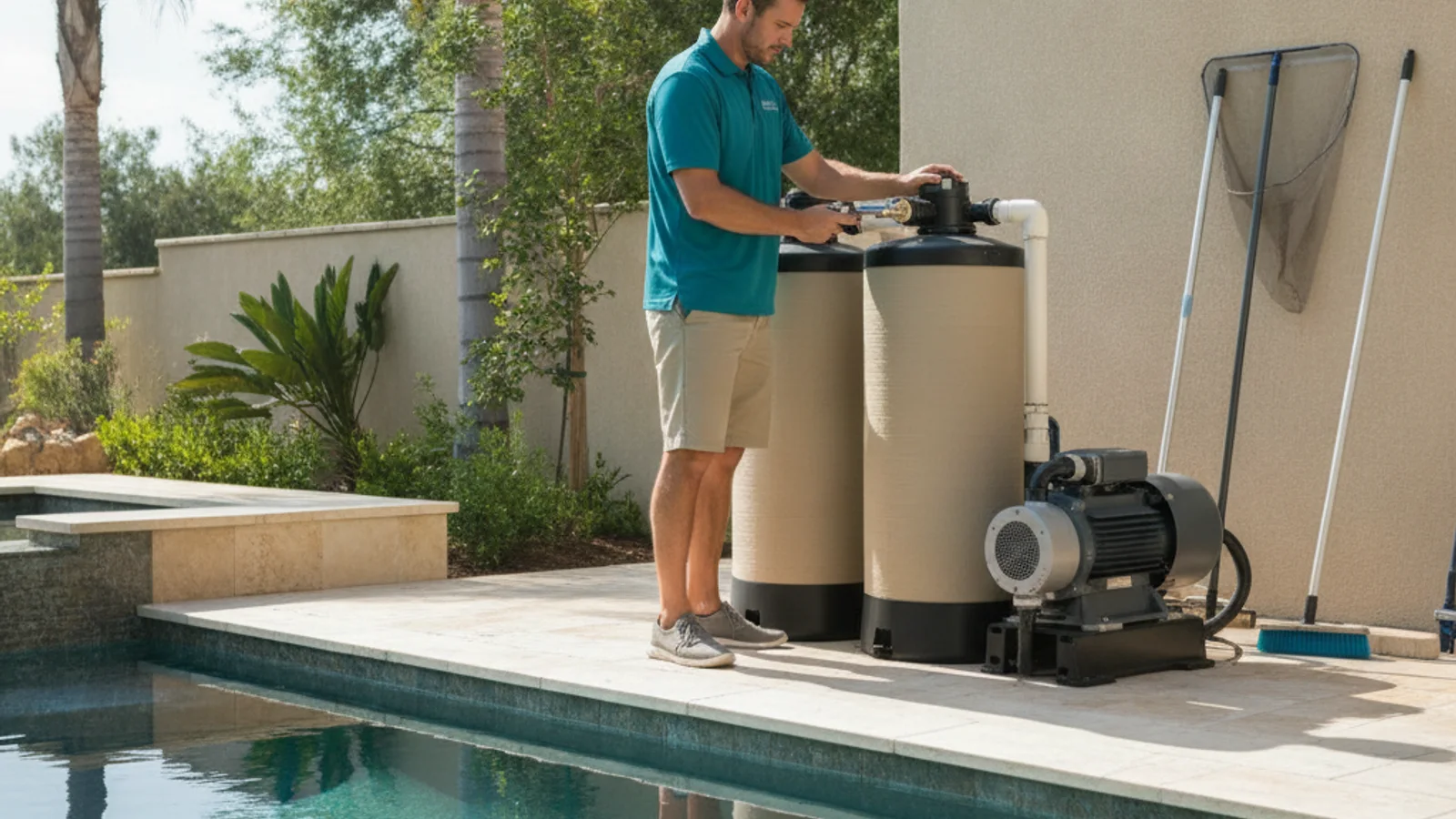
Your pool equipment stops working, and suddenly you’re staring at a green pool or no water circulation. Equipment failure is one of the most common and frustrating issues San Diego pool owners face — but most failures send a warning first.
How Pool Equipment Actually Fails
Pool equipment doesn’t just suddenly stop. It fails in stages.
Stage 1: Early signs — reduced flow, unusual sounds, slight leaks, or higher filter pressure. You notice something’s off, but the system still runs.
Stage 2: Partial failure — the equipment operates but at reduced capacity. Your pool gets warm slower, filter pressurizes faster, or circulation weakens.
Stage 3: Complete failure — the equipment shuts down entirely, often triggered by a safety shutoff or complete mechanical failure.
Most equipment sends Stage 1 signals for weeks or months before Stage 3. The owners who catch it early save thousands in damage prevention. Green algae blooms, calcium buildup, and dead zones in the pool all follow from ignoring early warnings.
Why Pumps Fail (And How to Spot It)
Your pool pump is the hardest-working piece of equipment. It runs 8-12 hours a day, moving thousands of gallons of water under pressure. Most pumps last 8-12 years with maintenance, but several issues kill them faster.
Cavitation — air bubbles entering the pump intake. The pump can’t push air, so it cavitates (makes a grinding, sucking sound). Usually caused by a clogged skimmer basket, low water level, or a leak on the intake line.
Seal failure — the shaft seal wears out, water leaks inside the motor housing, and the pump burns out. You’ll see water pooling under the pump pad.
Impeller damage — the impeller (the spinning wheel inside) cracks or breaks, reducing flow dramatically. The pump will run but your filter pressure stays low and circulation is weak.
Age — after 10-12 years, internal components wear. Seals dry out, bearings get loose, and the pump just stops turning.
Pump repairs often cost $400-$800. A new pump runs $1,200-$2,500 installed. If your pump is over 10 years old and failing, replacement is usually smarter than repair — new pumps are much more efficient, too.
Filter Pressure Problems: What It Means
Every pool filter has a pressure gauge. Normal operating pressure is 10-20 psi depending on the filter type. When pressure climbs above 25 psi, something’s clogged.
Rising pressure after backwash — your filter needs replacement. The cartridge or sand has accumulated sediment it can’t release. Time for new media.
Pressure never rises — either the filter is already loose/torn inside, or water is flowing around the media instead of through it. The filter looks clean, but it’s not actually filtering.
Gauge stuck at zero — the pressure line is clogged or the gauge is broken. Without a good pressure reading, you can’t track filter health.
Let filter pressure climb too high and you risk cracking the filter tank itself — an expensive failure. Replace the media when pressure hits 25-28 psi.
Heater Failure: Noise, Weak Heat, or Total Shutdown
Pool heaters run hot, run hard, and accumulate scale. Calcium buildup inside the heat exchanger is the #1 killer.
No ignition — the burner won’t light. Usually a faulty igniter or flame sensor. Fixable with a cleaning or sensor replacement ($200-$400).
Weak heat — water flows through but doesn’t warm up. The heat exchanger is scaled. You can flush it ($300-$500) or it’s time to replace the heater ($1,500-$4,000).
Loud rumbling or whistling — scale inside the exchanger or a cracked heat exchanger. Flushing might help, but a crack means replacement.
Shutting off mid-cycle — thermostat failure, flow sensor issue, or safety shutoff triggered by scaling. Most of these are fixable repairs.
Heaters over 10-15 years old are at high risk. The cost of annual service calls ($150-$300) vs. a new efficient heater ($2,500-$4,500 installed) becomes a breakeven question.
The Repair vs. Replace Decision
Here’s the rule: if repair costs more than 50% of replacement, replace it.
- Pump seal leak: repair $600 vs. replace $1,800 → repair makes sense
- Pump bearing failure at 11 years: repair $800 vs. replace $2,000 → replace wins
- Filter cartridge: replace $150 (not a repair decision)
- Heater with scale buildup at 14 years: flush $400 vs. replace $3,500 → flush first, but watch the clock
One more factor: efficiency. New equipment runs 30-50% more efficiently than 10+ year old gear. Your energy savings can pay for a new pump or heater over 3-4 years.
Prevent Failure Before It Starts
Running your equipment right prevents most failures.
- Run during daylight. Nighttime operation stresses equipment and doesn’t benefit your pool.
- Keep skimmer baskets clean. Clogged baskets kill pump suction and trigger cavitation.
- Check filter pressure weekly. Catch rising pressure before it damages the tank.
- Maintain water chemistry. Balanced pH prevents scale, corrosion, and heater damage.
- Service your heater annually. A $250 annual flush beats a $4,000 replacement.
- Keep the equipment pad dry. Standing water under your pump corrodes the motor.
What to Do When Equipment Fails
First: don’t panic. Your pool isn’t ruined.
Second: turn off the failing equipment. Running a dying pump or heater makes things worse.
Third: call a professional. Pool equipment is expensive and worth diagnosing correctly. A tech visit ($80-$150) beats guessing and making it worse.
We diagnose pool equipment failure every week in San Diego, and most of the time we can repair it — but only if you catch it early. The owners who bring us their pools at Stage 1 (when they hear a new sound or notice a leak) usually get a clean repair. The ones who wait until Stage 3 (complete shutdown) often face replacement.
Your pool equipment is trying to tell you something. Listen to it.
Frequently asked questions
How do I know if my pool equipment needs repair or replacement?
Most equipment fails gradually. If you're seeing reduced flow, odd noises, or water pooling, repair is possible. If the equipment is over 10 years old and failing, replacement is often more cost-effective than repair.
What causes pool pump failure?
Pool pumps fail from cavitation (air in the line), worn seals, impeller damage, or simply age. Most pumps last 8-12 years with proper maintenance.
Why is my pool filter pressure rising?
High filter pressure means the filter media is clogged. Backwash the filter first. If pressure stays high after backwashing, the filter cartridge or sand needs replacement.
What does a noisy pool heater mean?
Heater noise usually comes from scaling inside the heat exchanger, burner ignition issues, or water flow problems. This is often fixable by flushing or cleaning, but can also signal internal damage.
Should I repair or replace my pool equipment?
If repair costs more than 50% of replacement cost, replacement is typically the better choice. Older equipment (10+ years) should usually be replaced, not repaired.
How can I prevent pool equipment failure?
Run your equipment during the day, clean skimmer baskets weekly, check filter pressure monthly, maintain proper water chemistry, and service heaters annually.
Need professional help in San Diego County?
Refresh Pool Pros provides every service in this post. Call for a free quote.